



Travel preparation
- Home
- Services
- Accommodation for visiting delegates
- Practical guide for delegates
- Travel preparation
Entry formalities in Switzerland
The conditions for entering Switzerland vary according to the reason for the stay and the duration.
Do you need a visa?
Depending on your nationality, a visa might be required to enter Switzerland. To find out, visit Switzerland’s online visa system.
How to request a visa?
The visa request must be lodged at the competent Swiss Representation (embassy or consulate) responsible for the applicant’s place of residence. Visa application form can be download here and fill out online.
Appointment slots for visas are generally available up to six months before the planned date of travel, and it is preferable to make an appointment as early as possible to avoid any delays. Please note that it is not necessary to have all the required documents in hand when making the appointment, as these can be presented at the interview.
The inviting organisation must vouch for the person it invites to Geneva. Please consult the Checklist for inviting participants to meetings in Switzerland at the invitation of an NGO in order to review the different steps to follow in that context.
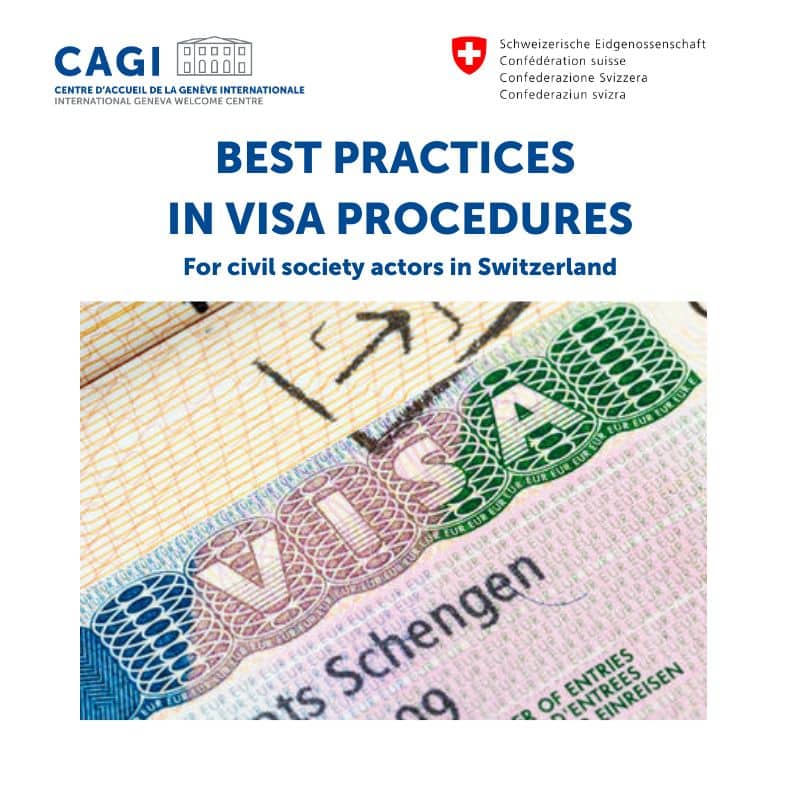
The informative note for people travelling to Switzerland within “International Geneva” provides further information on the issuance of visas and movement within the Schengen area.
Documents to provide
Un formulaire de demande de court séjour dûment rempli et signé par le demandeur. Le formulaire est disponible ici.
Whether or not they are subject to the visa requirement, any national of a third country (non-EU/EFTA) must, for a stay not exceeding 90 days per period of 180 days (short-term stay), have travel documents meeting the following requirements ( SEM, point 3 ):
- be valid for at least three months beyond the planned date of exit from the Schengen area,
- have been issued for less than ten years (the date of issue concerns only entry into the Schengen area).
The inviting organisation or conference secretariat must provide the delegate with a written invitation containing certain information.
- Sample invitation letter for NGO delegates (.pdf).
- Checklist for organising/hosting NGOs (.pdf)
- SEM FAQ (item 4)
The visa applicant must have taken out travel insurance with an insurance company recognised by the consulate processing their application. The list of recognised companies is available on the consulate’s website or can be obtained from the consulate.
Such insurance may also be taken out by a third party, for example the person who signs a declaration of financial responsibility on behalf of the applicant with a Swiss insurance company.
A certificate must be presented when applying for a visa.
Consult the list of insurance companies established in Switzerland and authorised by FINMA.
- A valid residence permit or equivalent document (e.g. exit/return visa) that allows the applicant to return to their country of residence;
- Two recent passport photographs;
- Proof of the delegate’s financial resources: recent payslip and recent certified bank statement;
- A hotel reservation;
- A flight reservation, including the return flight;
- For employees: confirmation from the employer stating the position, basic monthly salary, length of employment and confirming that the applicant will return to their job at the end of their stay in Switzerland;
- For self-employed persons: confirmation of their registration documents;
- Additional documents may be required by the Swiss embassy/consulate.
Entry/Exit System (EES)
EES is an European system that electronically records the entry and exit of third-country nationals in the Schengen Area to automatically calculate their length of stay. It replaces manual passport stamping with biometric data to improve border control efficiency, enhance security, and detect irregular stays.
European Travel Information and Authorisation System (ETIAS)
ETIAS is a new European travel authorisation system for nationals of non-Schengen countries who are visa-exempt, and it does not apply to citizens of Schengen countries. It aims to enhance security prior to travel and is expected to enter into force during the last quarter of 2026.
At this stage, no action is required from travellers, and the European Union will announce the exact start date several months in advance.
Import restrictions
Some products are not authorized in Switzerland. Consult the recommendations of the Federal Customs Administration .
Practical guide for delegates
Budget preparation
Partner hotels
Arrival in Geneva
Useful information
Delegates Information Desk
Services provided by CAGI
for visiting delegates

Contacts

Founded by the Swiss Confederation and the Republic and Canton of Geneva, the International Geneva Welcome Centre is the single entry point for the support and integration of employees of International Geneva and their families, NGOs and visiting delegates.
Délégués en visite
Participant aux conférences, réunions ou formations
Le CAGI apporte son soutien en matière d’hébergement et facilite le séjour des délégués lors d’une conférence internationale, réunion ou formation gratuite à Genève.
Les représentants de la société civile issus des pays en développement et de gouvernements des pays les moins avancés (PMA) peuvent bénéficier de notre accompagnement durant leur séjour à Genève.